|
Agriculture & Food
Security > Projects
Completed Projects
Indian Agriculture 2040:
Rapidly growing Indian economy will
call for a transformation of Indian agriculture over
the next 30 years that will have profound implications
for diversification for rural urban migration, for
agricultural profitability and food security. Challenges
to government policies would be daunting and most
likely will require a fundamental reorientation. IRADe
is involved in this study and has developed a general
equilibrium model to explore the issues.
Sponsored by Centennial Group, USA
Analysis of factors affecting productivity of Northern Flood Plains of eastern Uttar Pradesh
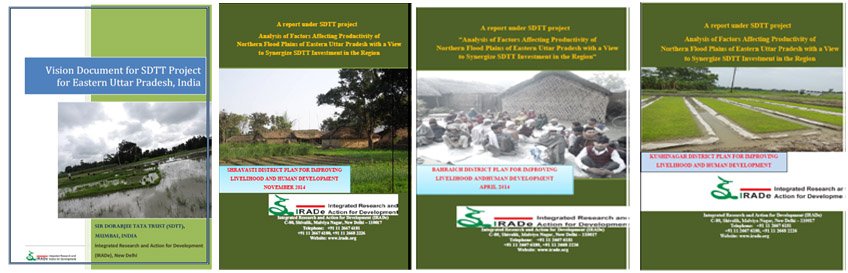
IRADe carried out an in-depth research to understand the drivers of growth and livelihoods and obstacles in the selected districts and clusters where Sir Dorabjee Tata Trust (SDTT) supported projects are undertaken by its partner NGOs. IRADe assessed the production and resource potential and devised strategies in consultations with stakeholders and participating NGOs to overcome various challenges encountered by the region,strengthen the clusters and generate synergy using data and analysis for Bahraich, Kushinagar and Shravasti districts, some of the poorest districts in UP.
In these districts electricity supply is poor, extension services are inadequate and certified seeds are not available in time. The irrigation potential of canals in Bahraich and Kushinagar is not fully realised due to siltation and poor management of canals. Private diesel operated tube wells are expensive. Credit to small and marginal farmers are inadequate.There exist large gaps between actual and potential productivity for major crops. Lack of proper marketing channel both for purchasing farm inputs and selling produce hampers diversification.
IRADe suggested strengthening of extension services with agri-clinics and agri-business as partners, improving canal management and diversification of agriculture to cash rich crops and measures to fully exploit the value chain of crops by utilizing byproducts in productive activities.
Key recommendations: Some of the major recommendations and interventions suggested for the area are to Improve livelihood opportunities to the area with promoting, fisheries, poultry, medicinal plants, mushroom farming, promoting horticultural activities. Other recommendations comprise of improving access to electricity through distributed solutions like gasifier, biogas. Improve access to water and sanitation through low cost solutions like sand filters, toilet linked septic tanks, flood proof hand pumps and toilet structures, low cost bamboo based toilet enclosures.
Under the project IRADe prepared detailed PRA reports of the surveyed clusters and 4 detailed reports: Vision plan for SDTT and three district level plans for Bahraich, Shravasti and Kushinagar.
Sponsored by Sir Dorabji Tata Trust (SDTT), Mumbai.
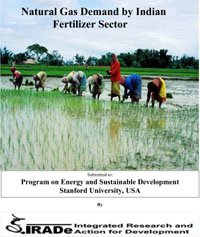
Demand
of Natural Gas in the Indian Fertilizer Sector study
2007-08
This study entails estimation of
demand for Natural Gas in the Indian Fertilizer Industry.
The objective of the study is to understand the policy
options of the Central Government in the face of changing
fertilizer future demand and supply scenario of Natural
Gas at the global level with particular emphasis on
India.
Sponsored by Stanford University,
USA under Programme on Energy and Sustainable Development
(PESD) Programme and China
Download
Report
Demand, supply and
subsidy analysis for Indian Fertilizer Sector
IRADe carried out this study to analyze
the fertilizer demand, to access the impact of various
feedstock prices, to estimate the total subsidy for
the fertilizer sector, to suggest range of policy
alternatives, to recommend viable policy and reform
options for policy-makers for India and to carry out
a comparative study of domestic policy and global
fertilizers policies.
Sponsored by The Department of Chemicals
& Fertilizers, (GoI)
 Extension
of Minimum Support Price (MSP): Fiscal and Welfare
Implications 2007-08 Extension
of Minimum Support Price (MSP): Fiscal and Welfare
Implications 2007-08
The Planning Commission, Government
of India awarded IRADe the research project to study
the implications of extending the Minimum Support
Price (MSP) to more states. After the analysis of
implication on the welfare of producers and consumers
in Madhya Pradesh and Uttar Pradesh, it was recommended
that MSP could be extended in many states, because,
more states are growing rice and wheat than earlier.
There are national gains in reduction in transport
of grains and more equitable benefit of government
policies.
Sponsored by The Planning Commission,
(GoI)
Download
Report
PROJECT
RELATED WORKSHOPS
Workshop on Energy Policy Reforms and Agriculture
in India: A general Equilibrium Exploration, 20
April 2004, New Delhi
Introduction:
IRADe organized a workshop on April 20, 2004 at India
International Center, New Delhi for launching the
Stanford-IRADe project to receive suggestions at the
inception stage. The overall objective of the workshop
was to discuss the various features in order to upgrade
the general equilibrium model.
The experts and representatives of
World Bank, Stanford University, ICAR, NIPFP, NCAER,
IGIDR, Planning Commission, Ministry of Power, IARI,
DFID India, USAID, Ministry of Environment & Forests,
Reliance Industries Limited, Indian Statistical Institute
(ISI) and University of Delhi attended the workshop.
Dr. P. Ghosh, Secretary, The Ministry of Environment
& Forests, (GoI), who earlier did computable general
equilibrium model, inaugurated the workshop. Professor
David Victor of Stanford University gave a keynote
address after which, Professor Kirit Parikh gave a
substantive presentation concerning the objectives,
methodology, possible outputs and policy implications.
The workshop recommended addressing
questions directly related to decision making for
land tillers and land owners and poor and small farms
such as disaggregation of farmers and some scenario
related to WTO.
Sponsored by Stanford University,
California, USA
Workshop on Food Security: Present and Futures,
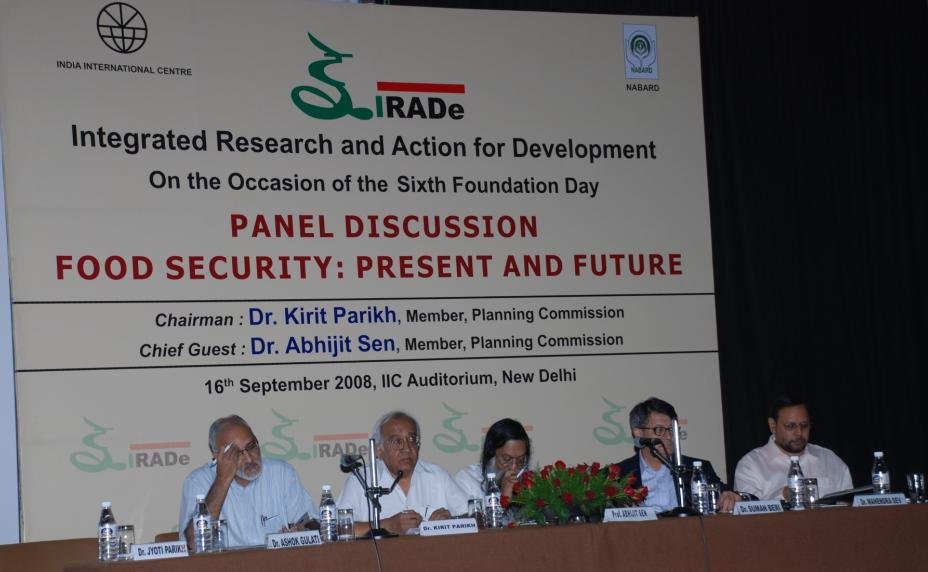
16th September 2008, New Delhi Introduction: IRADe celebrated
its 6th Foundation day with a panel discussion,
organized on "Food Security: Present and Future"
at India International Center on 16th September,
2008.
The workshop was attended by renowned
academicians and NGOs. Dr. Kirit Parikh chaired
the penal, and Dr. Abhijit Sen, Member Planning Commission
was the chief guest of the event. The eminent panelists
were Dr. S. Mahendra Dev, Chairman of CACP, Dr. Ashok
Gulati of IFPRI and Dr. Suman Bery, Director General,
NCAER.
The domestic self-sufficiency ratio
for food-security needs to be optimized. Climate Change
and food security issues should be dealt together.
To enhance food security, we need to focus on yield
growth in agriculture, a national development strategy
for handling the issues of excess labor in agriculture
sector, nutrition management of arable land in India,
institutional approach for collective action and rational
use of irrigation water.
|
|
|
|
Workshop on Food Security:
Present and Futures on 16th September, 2008
at IIC, New Delhi |
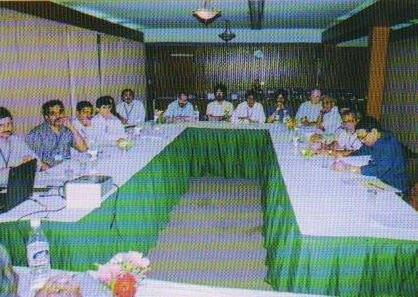
Workshop on Energy Policy
Reforms and Agriculture in India: A general
Equilibrium Exploration on 20th April 2004 at
New Delhi |
Other Related Activities:
ACTION RESEARCH, TRAINING, MONITORING
& EVALUATION (ARTME)
Policy Reforms are underway in many
sectors. These have generated path-breaking programmes,
schemes such as RGGVY, MNRE schemes on solar cities
or village energy security programs. They have potential
to increase economic efficiency in rural areas. Some
of them may need to be more effective. To appreciate
ground realities facing the schemes, programmes and
policies, IRADe has surveyed and examined impact of
energy sector reforms on poor and rural sectors. Each
study has analyzed and has generated suggestions and
recommendations to enhance the effectiveness of the
government programmes. The MNRE, UNEP and UNDP have
utilized services of IRADe in conducting International
training programs on renewable energy and gender issues.
Evaluation of Franchisees System
in the states of Assam, West Bengal, Nagaland and
Rajasthan
The Ministry of power had awarded
a study to IRADe to access franchisee system in Assam,
Nagaland and West Bengal. REC awarded further
studies to IRADe for evaluating the franchisee
systems operating in different district distribution
circles in states of Assam, West Bengal, Nagaland
and Rajasthan through sample villages in these states.
MoP project covered villages in Bankura district,
Dibrugarh district, Nagaland & REC project survey
included villages in Purulia, Jodhpur and New Bongaingaon
districts. Conclusions were drawn from the studies
that franchisee requires adequate supply of power
of good quality maintained by utilities to work effectively;
capacity building of franchisee should be done in
the beginning. A part of 90% subsidy provided under
RGGVY projects should be given by the govt. to the
rural population.
Sponsored by The Ministry of Power,
(GoI)
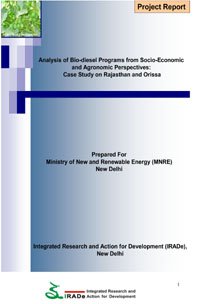 Analysis
of Bio-diesel Programs from Socio-Economic and Agronomic
Perspectives: Case Study on Rajasthan and Orissa. Analysis
of Bio-diesel Programs from Socio-Economic and Agronomic
Perspectives: Case Study on Rajasthan and Orissa.
This study attempted
to identify and fill critical knowledge gaps, which
currently inhibit effective policy on Bio-diesel in
India to delineate the key challenges in the Jatropha
cultivation in consonance to find ways to scale up
the outreach of services to the poor and vulnerable.
The study analyzes various socio economic parameters,
agro climatic conditions and other multi stakeholders
consisting of oilseeds cultivators, with regard to
Jatropha. The project identifies the primary barriers
of Jatropha plantation for socio-economic feasibility
of a multi-stakeholder system with a focus on rural
population. Biofuel promotion is a very complex issue
dependent on knowledge, infrastructure support, policy
issues, political environment, inter-sectoral cooperation
and linkages for the cooperation and technology promotion
and transfer. Feedstock supply and management chain
emerge as a most important issue for the promotion
of Bio-diesel from Jatropha, considering site-specific
climatic, agronomic, economic, and social conditions.
Sponsored
by The Ministry of New and Renewable Energy, (GoI)
Download
Report
Evaluation of Solar Thermal Demonstration
Project in 4 states of India
The project was awarded by MNRE.
The MNRE had provided the villages' residents in four
states namely Rajasthan, Haryana, Uttarakhand and
Gujarat, with solar cookers and solar water heaters.
Overall the users of solar thermal products were satisfied.
90% of users felt that food cooked with solar cookers
tasted better and good for the health. They were happy
that solar cooker did not require fuel, and needed
little maintenance. They were aware that solar system
had long operational life, can be used during day,
but also depends on the seasons.
Sponsored by The Ministry of New
and Renewable Energy, (GoI)
Survey and evaluation project of
remote village area electrification through solar
photo-voltaic system in the state of Rajasthan and
Haryana
The project was awarded by MNRE.
The MNRE had provided the residents of remote villages
of India, which could not be covered by national power
grid, with solar home lighting systems and solar street
light systems. It was observed that target oriented
approach was followed during implementation. During
implementation by parties, MNRE guidelines were not
adhered to in totality by implementing agencies. Approximately
15% of the systems were found to be non functional.
Maintenance and service support from equipment suppliers
desired improvements.
Sponsored by The Ministry of New
and Renewable Energy, (GoI)
Evaluation of Solar Photovoltaic
Program in 6 states of India
The project was awarded by MNRE.
The MNRE had provided the villages' residents in six
states namely Rajasthan, Haryana, Uttarakhand, Gujarat,
Manipur & Karnataka, with solar home lighting
systems, solar water pumps, solar lanterns and solar
street light systems. The Study was structured on
field visit based verification and collection of beneficiary
level information; on functioning and maintenance
of systems, and satisfaction level of beneficiaries.
The life-style of beneficiaries has changed gradually
following work done under the scheme. The benefits
accrued were, working hours for useful tasks have
increased, study hours of children increased, consumption
of kerosene declined, environmental accidents such
as snake and insect bites declined. Beneficiaries
have started using mobile phones, radios, telephones
etc.
Sponsored by The Ministry of New
and Renewable Energy, (GoI)
International Training Programmes, 2004,
2005, 2006 and 2007
IRADe organized International
Training Programmes (ITP) for 4 years, every
year since 2004 on Renewable Energy Technology (RET)
for participants from Asia and Africa. So far,
four ITPs have been organized on various topics under
Renewable Energy Technology (RET). They were as follows:
Renewable Energy
in Local, national and Global Context with Socio-economic
Perspectives", March 2004
"Renewable Energy:
Techno- economic, Finance and Socio- Environment
Issues", 7-17 December 2004
"Alternative
Fuel: Energy Security, Techno economic and Environmental
issues" 23-30 March 2006
"Role of Renewable
Energy in Energy planning and expanding Livelihood
Options", 14-22 March 2007.
Participation:
Participants
were middle or senior level officers (Director, Executive
Director, Advisor, Assistant Professor, Assistant
lecturer, Lecturer, Manager, Program Officer, Engineer,
etc.) from Ministries, non- government organization
and from different universities of Asia and Africa.
Countries participated were as follows;
Asia: Nepal, Bangladesh, Pakistan, Iran, Sri Lanka,
Vietnam, Cambodia, Thailand, Indonesia, China
Africa:
Nigeria, Tanzania, Cameroon, Sudan, Malawi, Algeria,
Uganda, Camaroon
Sponsor:
The Ministry of New and Renewable Energy (MNRE),
GOI
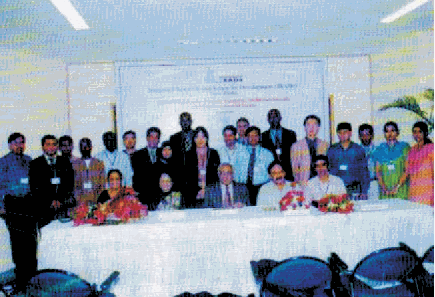
Prof. Jyoti Parikh, Executive Director, Mr.
V Subramanian, Secretary MNES with the participants
of 3rd International Training Programme. |
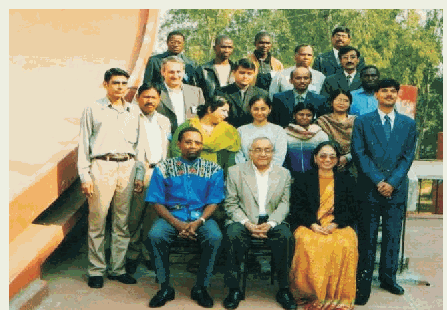
Participants of 2nd International Training Programme
on Renewable Energy from Asia and Africa and
IRADe staff |
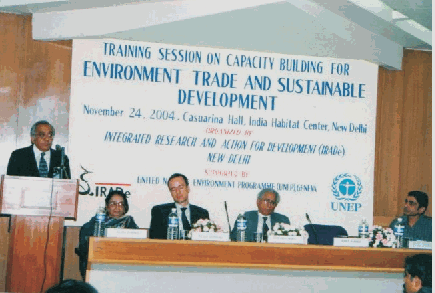
IRADe-UNEP Workshop on "Training Session on
Capacity Building- Environment, Trade and Sustainable
Development" 24 Nov 2004, at New Delhi |
|